


By Elaine Kasket
When the House of Beautiful Business asked me for an expert view on how agentic AI will change organizations—and the underlying philosophical concept of “agency”—I was hesitant. As a cyberpsychologist I write a lot about the human experience of power, agency, and control related to technology. As a coach, I work with people within organizations, while remaining (helpfully, perhaps) external to those organizations. Would I have enough to say about what happens inside organizations and on the client side? Would I have the right kind of expertise to comment on “ecosystems of agents,” as the House’s invitation read, in this context?
While my starting point was doubt about my ‘expertise’—a word that implies deep content knowledge, a power-over position, and perhaps imperviousness to challenge—I’ve been pondering the term ‘thought leader.’ If ‘thought’ is read as a noun, it’s not so different to ‘expert’—something guru-esque in the sense of ‘I shall tell you what to think.’ But if I read ‘thought’ as a verb, as a process, and read ‘leader’ as an inclusive ‘let me take you with me,’ I like that much better.
In this spirit, I want to take you with me on a very non-AI, human, messy whistle-stop tour of my thought process in engaging with the question of agentic AI and agency. I was curious about a succession of things, a variety of angles, a cascade of questions. I moved through a variety of stages, so here they are.

Move one: Every agent has an agenda
As a functional contextualist, I pay a lot of attention to language—languaging as behavior, and how that behavior is functioning in a particular context. So sometimes I go back to etymology. In Latin, agere is ‘to drive, to do, to act,’ and agentum means ‘one who acts.’ Agendum is ‘something to be done.’ When I read the phrase ‘agentic AI,’ these Latin roots remind me that AIs are entities acting on behalf of someone in service of something.
An AI’s agenda is defined by powerful humans, from conceptualization to design to implementation. Those humans have certain values, motives, and desires that are not shared by everyone, nor are they in service of everyone’s interests. On the one hand, they are nascent and incredibly new; at the same time, they are taken for granted and constantly framed as inevitable. That stood out to me in the House’s invitation, when I read the sentence “brands will increasingly operate within ecosystems of agents.”
Incontestable.
This assumption echoes the perspectives and assumptions of Anol Bhattacharya and Tim Leberecht in their Beauty Shot conversation a few weeks ago. And it’s a perspective which many, if not most of us, have come to share, wherever we stand in the food chain of power and influence in this space. In some ways, I share it, too. In some ways, I’m as excited or intrigued about the possibilities as Anol is.
But when we exercise our own agency, whose agenda are we serving, in line with what principles and values? What and whose agenda are we implementing when we choose and deploy agentic AI in our organizations? Whose agenda (and values, and interests) are ignored in the process? What human agendas are baked into the AI agents? How are we telegraphing what and who matters most in our AI-related choices?

Move two: The blind men and the elephant
I use AI. I marvel at how much power it gives me, how much all of my technology does for me, all for what is (to me), a nominal amount of money per month. I walk through a green park in a first-world country, the sun is shining, I am aware of my privilege but take it for granted, and I have a clean, smooth rectangle in my uncalloused hands. When it becomes too slow or full for me, I’ll probably get a different one. I don’t experience this as particularly problematic, if I am not actively reflecting.
But I’ve been reading Kate Crawford’s Atlas of AI and becoming increasingly uncomfortably aware that, like the parable of the blind men and the elephant, I’m only touching one part of the elephant, and since I can’t see the other parts of the beast, those parts seem distant and easy to compartmentalize. I use technology every day, largely blissfully ignorant of, or motivated to suppress my knowledge of, its means of production.
However, as Crawford shows, every AI interaction has a material substrate in resource extraction, energy consumption, and environmental degradation through rare-earth mining. Furthermore—and this is something of which I was very little aware—there are countless invisible, undervalued workers. Data labelers, content moderators, platform workers, lithium miners, and even people involved in ‘fauxtomation,’ which involves tasks ostensibly being automated but actually being done by humans. Just as we engage in a certain amount of pragmatic death denial to enable us to get on with our lives without being overwhelmed by existential terror, we bracket off or turn a blind eye to or never engage with the question of less-apparent costs and consequences.
These lacunae, these cognitive gaps, help us cope psychologically with participating in systems that might overwhelm or horrify us if we held the whole elephant in mind, or came face to face with its most unpleasant bits. We might become aware—but then we relegate it to what some existential psychologists call “unreflected consciousness.”
Like meat-eaters who decline to tour the factory where the sausage is made, we cognitively externalize and disregard environmental and social consequences that are more distant from/inaccessible to us. Because then it might become clear that we need to slow down, to change, to allow ourselves to be inconvenienced.
In the conversation between Tim and Anol, it was very interesting to watch what was happening with some of the language in Tim’s intro and in the subsequent exchange. I was struck, for example, with Tim saying, “AI agents operate with singular, linear, monolithic intent…efficient, ruthless.” And he goes on to talk about the actors looking for a plot, for the human input to shape them, to give a prompt. But that account (unintentionally, I’m sure) erases the human inputs that have already gone in to make the AI agent exist in the first place, and that continue to exist to maintain it—the miners, the crowdsourced testers and clickers, the fauxtomatic agents.
When businesses get super excited about agentic AI that we can delegate things to, or that can delegate things itself, are we still speaking about systems that rely on invisible human workers, as Crawford describes? They’re being excised from the narrative, and hence from awareness. If we think we’re merely managing ‘digital agents’ who cannot be hurt (we often use language like, ‘never needs a coffee break, never needs a holiday, can work 24/7’) then we won’t realize that we’re still exploiting human laborers—we fall victim to the comfortable fallacy of clean tech. And we’re able to concentrate on capitalist values like innovation and efficiency because of what (and who) we are making invisible in our narrative.
What might we do differently if we remove the blindfolds and force ourselves to acknowledge the whole elephant in the room?

Move three: Discomfort with the word ‘ecosystems’
I became acutely conscious of my discomfort with the word ‘ecosystem’ in the phrase “ecosystems of agents” that the House used in its invitation. I was curious why. I found myself thinking about Kate Raworth’s Doughnut Economics, which I read a few years ago for a book club (I don’t think I would have picked up a book about economics of my own volition). It had stuck with me, so I went back to it to try and work out why I was making this connection.
Raworth focuses on questioning and overturning the long-taken-for-granted growth imperative (e.g., endless GDP and year-on-year increasing profits), because it’s unsustainable, unsafe for the planet, and hence not conducive to our long-term thriving, whatever the short-term goals. She challenges us to move towards regenerative rather than extractive business models, and her doughnut framework describes environmental and social costs as central to decision making, not secondary or irrelevant. Raworth wrote Doughnut Economics before the current AI explosion, but I can extrapolate from what she writes about how we need business models that will meet our human needs (which includes organizational sustainability and effectiveness) while respecting planetary boundaries at the same time.
Any organization using Doughnut indicators would probably immediately have to acknowledge that the current pace of AI acceleration pushes outside of safe operating boundaries. I reckon so, anyway, having read Kate Crawford. In Doughnut Economics, Raworth says, “talking of ‘natural capital’ and ‘ecosystem services’.…simply shifts the living world from being man’s material to being an asset on his balance sheet.”
When I read the phrase “ecosystems of agents,” I realize now it grated because linguistically it’s taking a word (ecosystem) that’s traditionally referred to interdependent systems of life and making it a metaphor for division of labor and allocation of resources, which serves the organization’s profits while simultaneously disregarding the natural ecosystem that’s being harmed. Every time we mention ‘AI ecosystems,’ we should remind ourselves that we are embedded in actual ecosystems that are under unprecedented stress; that our not-so-clean tech exists within and depends on humans, often exploited ones; and that for us carbon-based life forms, health, and thriving are intimately connected with living systems.
I remember Charles Eisenstein speaking at the House of Beautiful Business festival in 2021 in Lisbon. In his work, he talks of the “connected living self in co-creative partnership with the Earth.” Kate Raworth wonders if one of the reasons people squirm at this kind of language or resist it is because we feel awkward or embarrassed at being forced to consider just how much we neglect an extraordinarily important, even crucial, relationship between us and our habitat. How we are riding roughshod over it.
I’m wondering about a concept of cognitively-regenerative AI, or maybe…agency- regenerative AI. In that phrase, I’m referring to human agency, and all its connections to power, values, creativity, deliberate action, ways of knowing, ways of connecting.
What if AI systems were designed to enhance rather than diminish human agency, creativity, and connection to ecological and social systems? What do organizations need to do to maintain human agency, dignity, and value within technological systems? And while we’re at it: Why should philosophy be something that happens at the back end of an unreflected process, one that humans will engage in after AI has taken over? Shouldn’t we be applying philosophy now, at the front end, to make this whole process of AI adoption (or not) more reflective and reflexive?

Move four: The growth imperative, and other unquestioned capitalist values
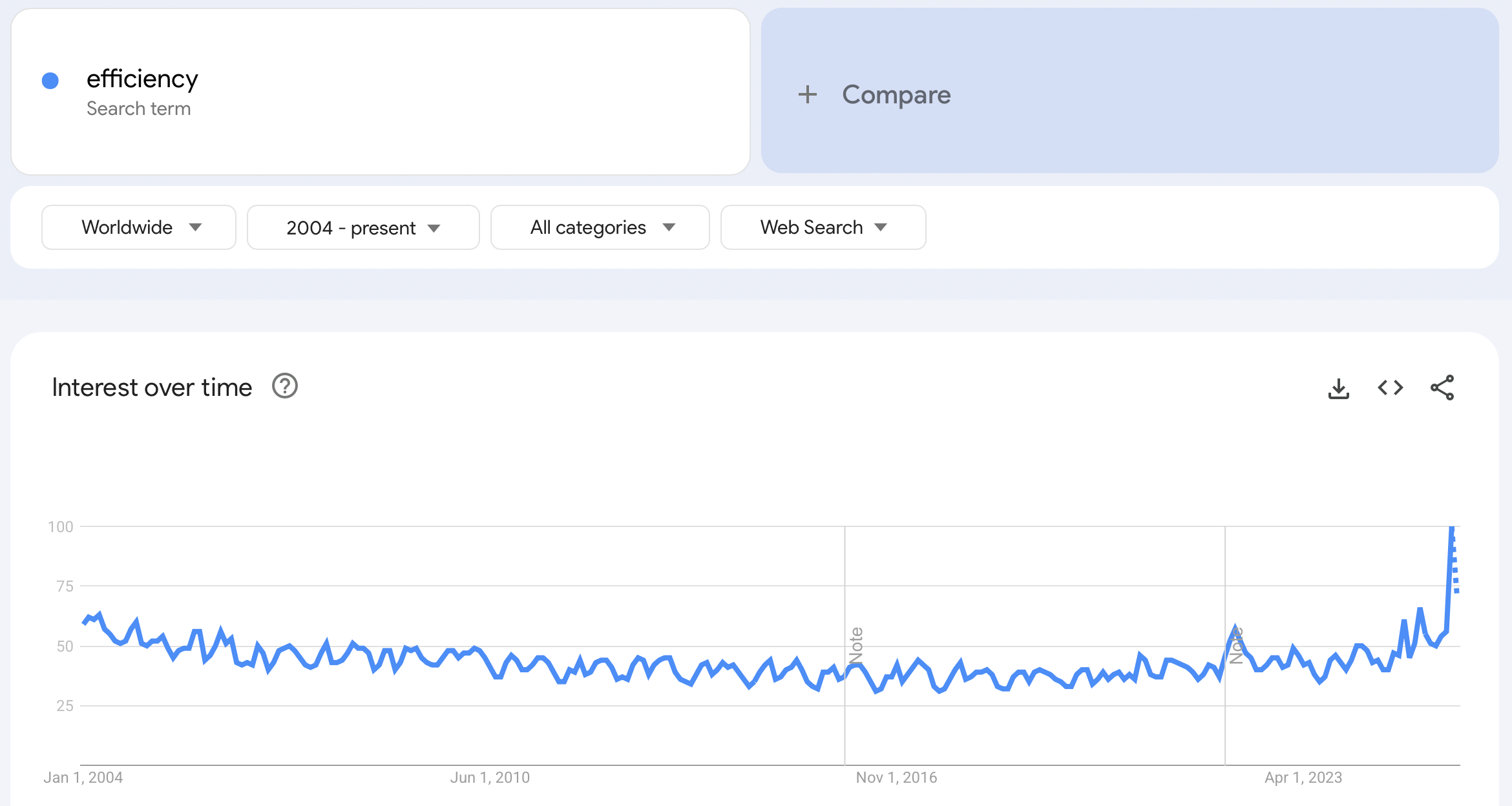
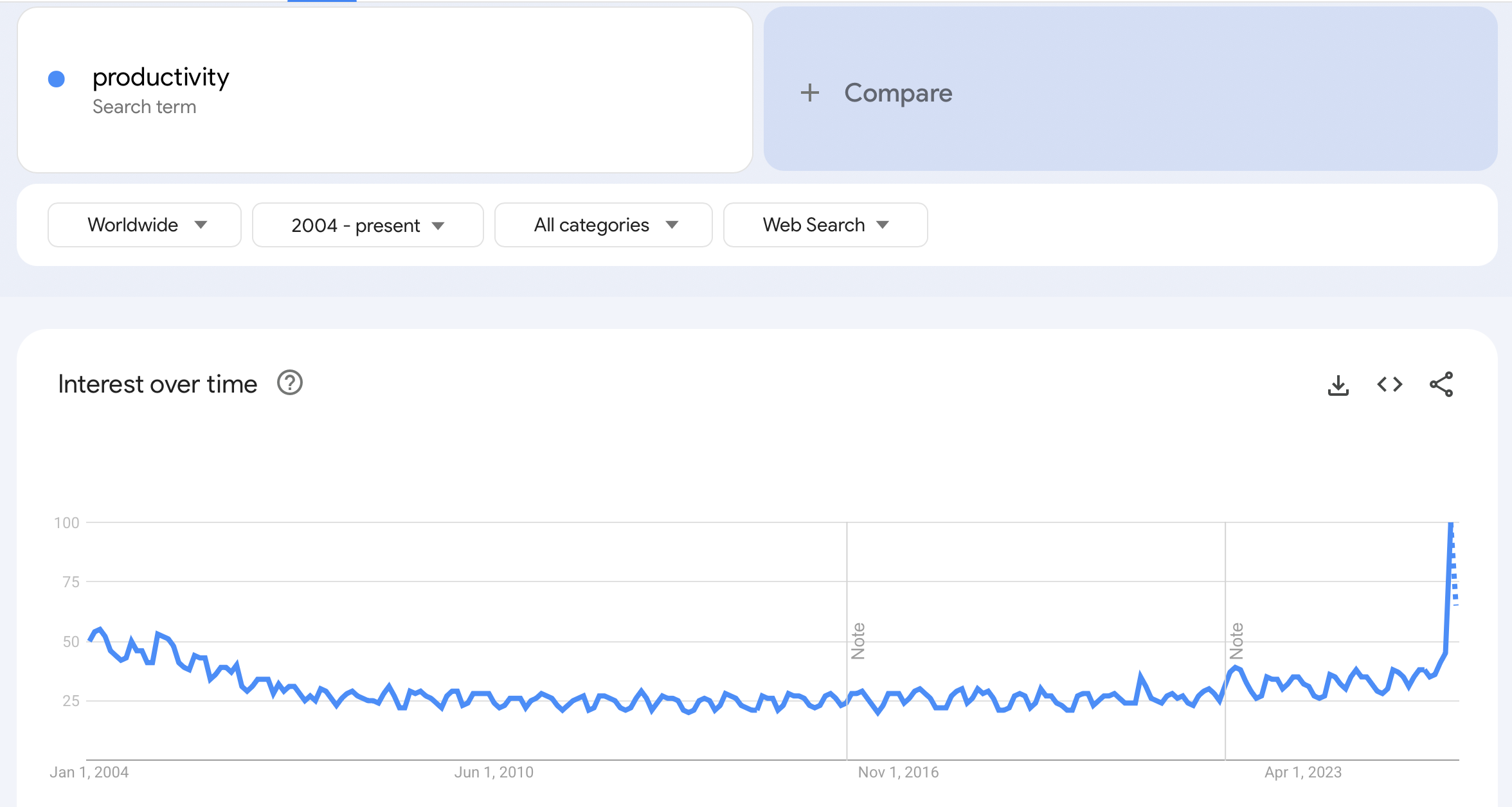
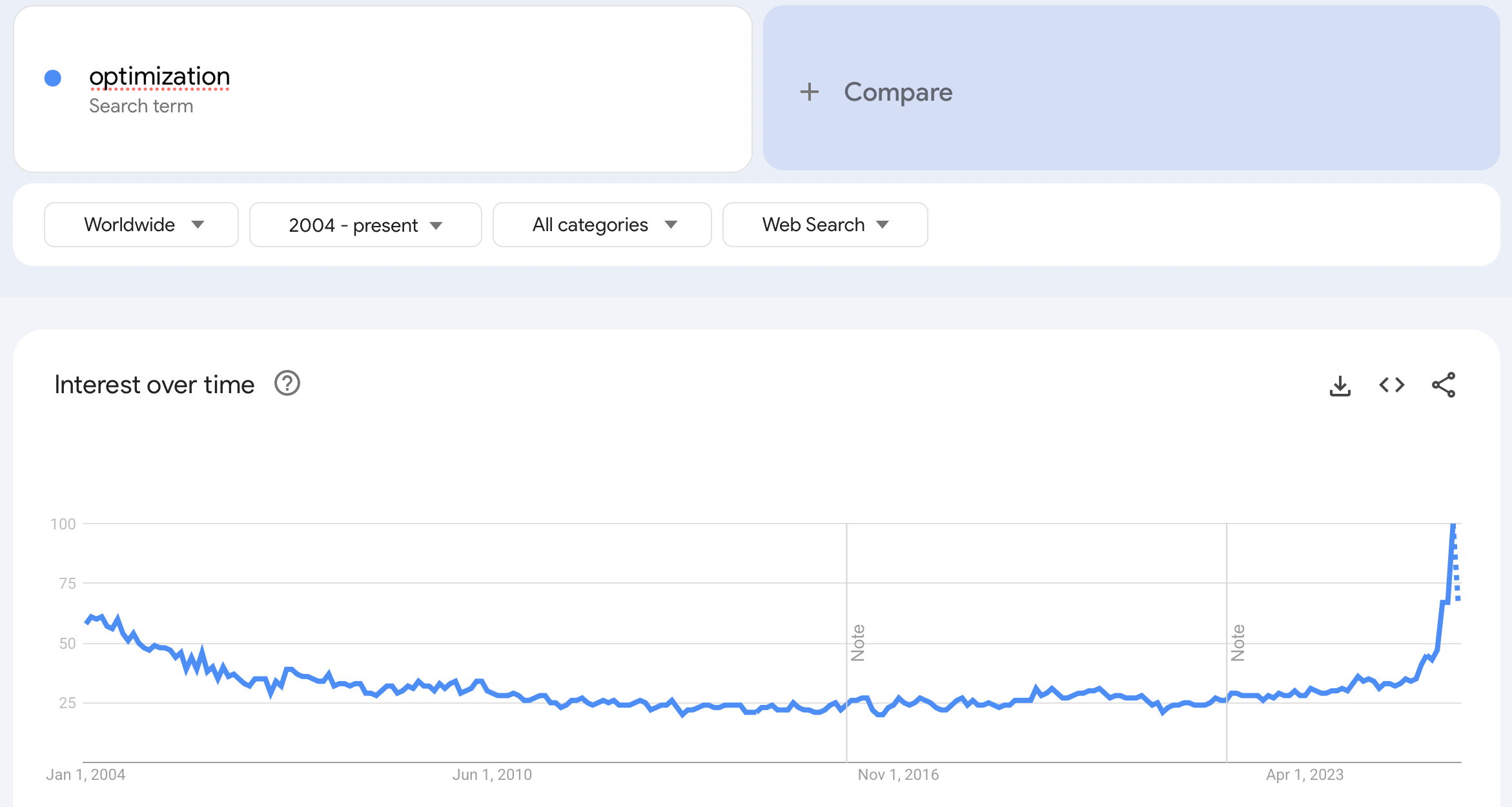
Raworth speaks a lot about the problem with the growth imperative, and other unsustainable corporate and organizational values. I did a little experiment. I plugged a handful of words into Google Trends: efficiency, productivity, optimization. I looked at the graphs representing global keyword-search interest in these terms over the last 20 years or so, since 2004.
Each graph’s right-hand spike is currently at 100. Basically, that means that we’re currently sitting at the highest search interest for each of these terms of the past two decades. We’re seeing historical highs in search attention on all of them, simultaneously.
The public conversation around efficiency, optimization, and productivity, at least as it’s measured by search interest, is as hot as it’s ever been since 2004.
What does this reflect?
Clearly, people are seeing these concepts, which we could also frame as values, as salient, important, need-to-know, urgent. It might also indicate anxiety: people are trying to understand or cope with, or prepare for something they think is coming.
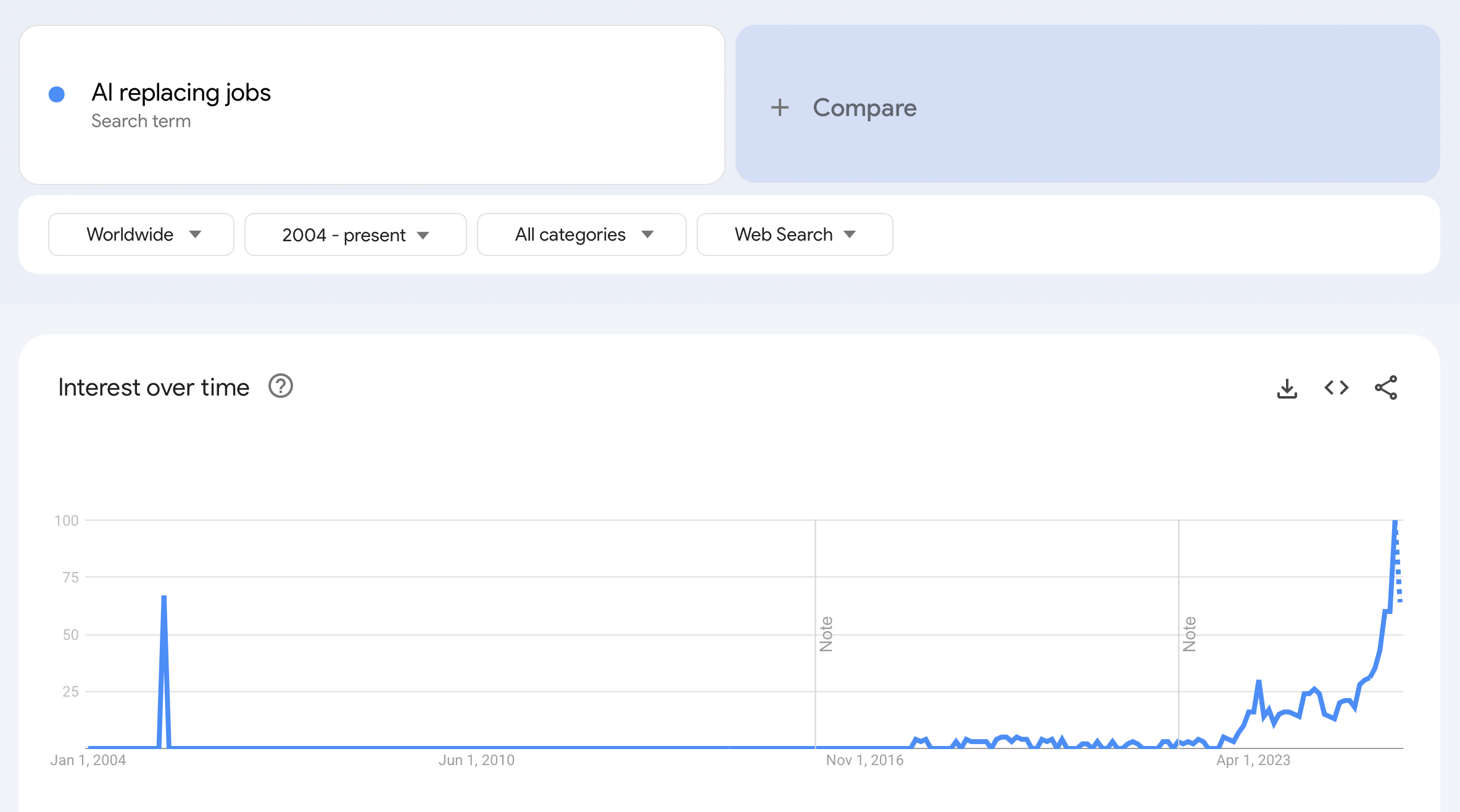
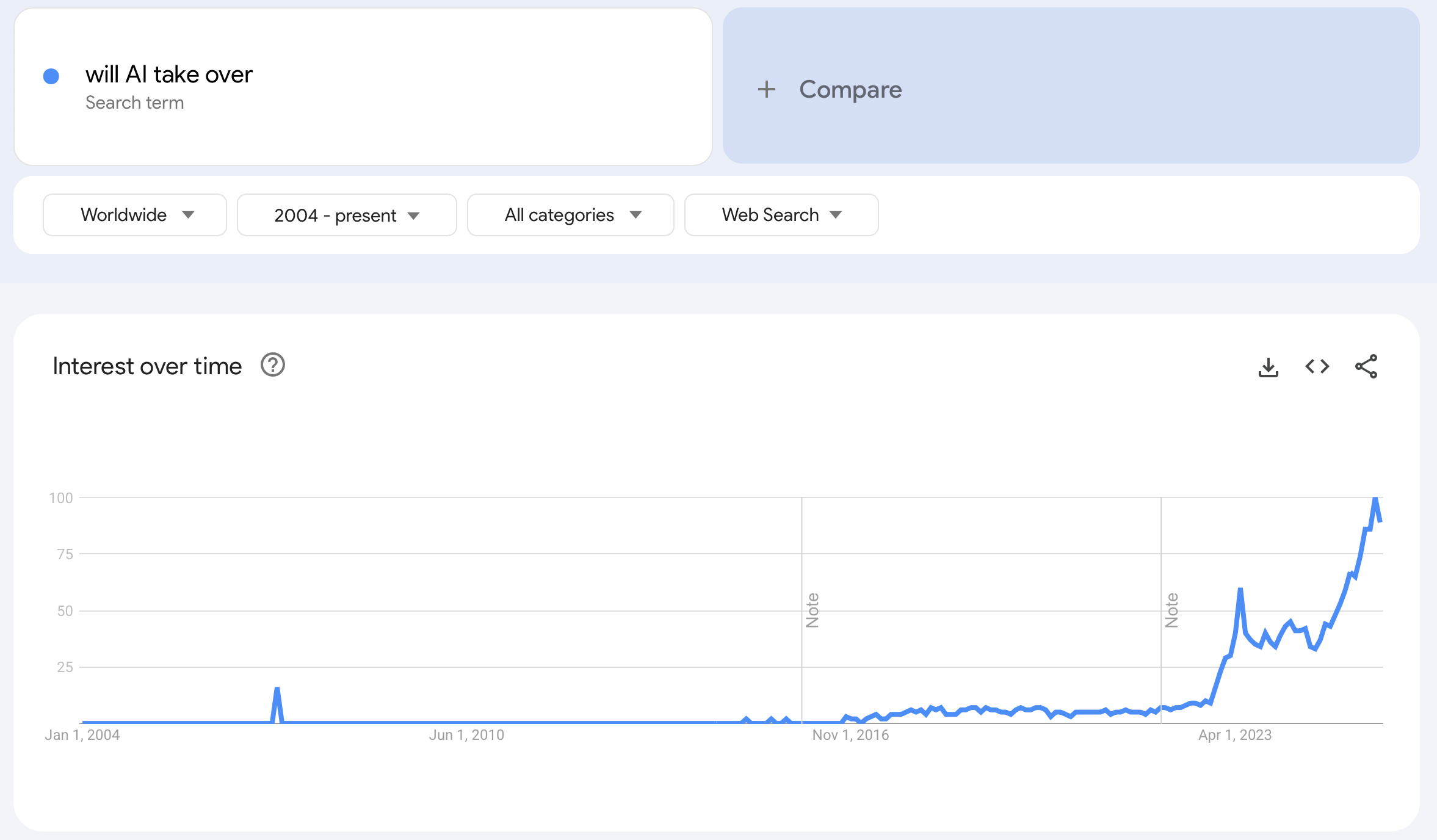
And what is the impact of such a constant message, such a clear presence of these things in the narrative? All these words hitting historic search-term highs at once?
With this drumbeat of importance, people won’t just experience these traits as desirable—they’ll feel mandatory. AI and automation are constantly being promoted as the way to achieve all these things—efficiency, productivity, optimization—and so it adds to the feeling of resistance not only being futile, but also unwise. You’d have to be stupid to not adopt it, to go with the flow, right?
But following through on your knee-jerk, emotional, even existential reactions to the powerful and persuasive narratives in the prevailing discourse—that’s not the same thing as thinking deeply, evaluating, reflecting. I get it. Has it ever been harder, more of an act of apparent recklessness, to slow down and take a beat? But then again, is mindless, anxiety-driven, FOBO (Fear of a Better Option)-fueled decision making what meaningful human agency or even humanity looks like?
I saw these taken-for-granted priorities and values at play in the conversation between Tim and Anol in the Beauty Shot conversation. Anol’s thrill and excitement at the idea of running a marketing campaign at huge speed, in 24 hours. His conviction that a “white-collar bloodbath” is inevitable. His saying, “disrupt yourself before someone else does,” carrying as it does a sense of possibly false urgency, constructed emergency. The celebration of delegating “the boring stuff” to AI, which dismisses both (1) the potential value of humans continuing to engage deeply with information and processes, and (2) the massive and oft-exploited global underclass making the AI possible in the first place.
Unquestioned, unreflective conformity to AI-embracing discourse nudges us right out of the regenerative perspectives of Kate Raworth and Charles Eisenstein, straight out of the doughnut. In terms of psychological defense mechanisms, enthusiasm about technological progress may be a kind of reaction formation (Anna Freud) where we embrace the religion of efficiency, productivity, and optimization to avoid and deny our ecological and existential guilt (or even terror).
The late Mark Fisher, author of Capitalist Realism, said it was easier to imagine the end of the world than to imagine the end of capitalism—and, like David Smail, he identified various types of human malaise (anxiety, depression, meaninglessness) as being societal, political, and economic in origin. So yes, to question ideologies that are so entrenched and embedded, to check our unthinking use of language that perpetuates those ideologies, takes awareness and courage. It means risking being seen as idealist, naïve, impractical in a capitalist culture that prioritizes productivity, profit, efficiency, speed, optimization.
But this courage represents, I believe, an untapped brand opportunity. Organizations that dare to slow down, reflect, and question are choosing conscious human agency over automatic, machine-like, reactive adaptation. This is the kind of rebellion that many customers may appreciate more than we realize.
Move five: Technology’s ‘enframing’—the danger and the saving power
The philosopher Martin Heidegger described how technology has the tendency to position everything, including humans, as resources to be optimized and managed. He called this the ‘enframing’ nature of technology. Heidegger warned that when enframing becomes total through its having been unquestioned, we lose the ability to see or act on alternatives. We become so entrapped in technological thinking that it becomes impossible to step outside of it.
At the same time, Heidegger argued that if we continually question technology (hence the title of his essay, The Question Concerning Technology), if we don’t fool ourselves or lie to ourselves about this danger, we can step back and preserve the possibility of other ways of being—ways of being and doing beyond blind technological solutionism and technological ways of viewing human beings.
When I see the phrase “we are all agents;” when I look at the Google Trends graphs for efficiency, productivity, and optimization; when I see the unreflected and automatic languaging of inevitability in the discourse, I sense we’re at a threshold, a point where the total surrender to technological ‘enframing’ that Heidegger spoke of is dangerously close. We could easily step into it, over the threshold, into the void.
The ‘agentic AI’ or inevitable ‘ecosystem of agents’ narratives accelerate this acceptance, nudging us over the threshold, by making ‘enframing’ feel like empowerment. (By the time we’re all spending our time philosophizing, AI having taken over all other functions, it might be too late to take Heidegger’s advice into account.)

Move six: Foucault and discourses of power
In graduate school, I learned about (but did not practice in a significant way) Foucauldian discourse analysis. While I don’t know about it in great depth, I do remember the central tenant of this mode of analysis: Discourses don’t just describe reality. They produce it. So this very strong ‘adapt/accept or die/fail’ rhetoric serves, in Foucauldian terms, as a kind of discursive coercion. Organizations’ narratives about AI contain powerful (and even coercive) reality-shaping themes of: inevitability (AI is unstoppable, irreversible, cat-out-of-the-bag, horse-out-of-the-stable); survival (if you don’t adopt it, you’re not just behind the times, you’ll be eliminated); and moral imperatives (if you hold back progress, you’ll let down your customers and shareholders).
Does the discourse shape reality, or does reality shape the discourse? Both, of course. But we underestimate the insidious power of the former, and by extension, underestimate the agentic power we wield by questioning and changing the discourse.
Toward agency-regenerative AI
The idea that “we are all agents,” as expressed in Tim’s intro and the conversation with Anol in their Beauty Shot conversation risks obscuring a fundamental distinction that we should really hang onto: we are genuinely different kinds of agents, AI and we humans. The types of agency we are capable of are different. Human agency is connected with and emerges from embodied experience. Emotional complexity. Moral imagination. Genuine (not merely performed) empathy. Embeddedness with living systems. And the ability (if only we have the will to remove the blindfolds) to comprehend the whole elephant.
AI ‘agents’ operate through algorithmic optimization, within predetermined parameters, parameters that are set by powerful humans with specific (often unreflected, unacknowledged, and/or unexpressed) agendas. When we collapse this distinction, claiming here are we all, human and artificial agents, operating together in a new-style ‘ecosystem,’ we risk designing and running organizations that systematically, unthinkingly diminish those things that make human agency so valuable and irreplaceable.
I understand that the technical definition of ‘regenerative AI’ has to do with self-improving systems that can adapt and fix themselves. I understand that ‘regenerative AI’ can also be used to speak about sustainability projects aimed at environmental benefits of various types. But what if we thought in terms of agency-regenerative AI? Agency-regenerative AI could be designed to preserve and regenerate human cognitive capacities currently being eroded or threatened by current technological approaches and agendas embedded in growth-imperative capitalist perspectives.
Agency-regenerative AI could be designed to enhance humans’ capacity for slow, deliberative thinking; to encourage us to question rather than optimize; to prompt us to remember our embodied connection to actual ecosystems; to encourage us to imagine alternatives; to nudge us towards collaborative meaning making.
But that’s an idealistic thought, and beyond most organizations’ control. What about the more realistic situation? Even while using currently available AI, or the move-fast-and-break-things AI of the probable near-future, leaders can still consciously design their relationship with and decision making around existing AI to preserve, rather than erode, human agency within their organizations. By interrogating current AI discourse within the organization, by resisting ambient pressures towards acceleration and unquestioned acceptance, and by working towards truly regenerative approaches, brands can set themselves apart.
So where have I got to? Perhaps a collection of human-centered, human-agency-centered questions for organizational reflection.
The Agency-Regenerative Checklist
How can we think about agentic organizations in a way that’s different to the direction in which we’re being pushed?
In strategic communications, presentations to investors, conversations with everyone inside of the organization, what agenda are you communicating when you talk about AI adoption?
Whose agenda? Whose interests and values are really being centered, and who and what is being erased? What values are implicitly embedded in your communications?
How can you make space for the kind of slow and deliberate thinking that considers all the humans involved, and weighs the less visible, longer-term costs and consequences? Only through this kind of deliberation can you see, feel, acknowledge, and honor the whole elephant. There’s so much blind adherence to EPO (efficiency, productivity/profit, optimization) that we forget the eco. What does that elephant look like and how do you feel about it when you include all the hidden labor and environmental costs (past, present, future) of your AI decisions?
Can you resist the false urgency and the competitive treadmill while still being innovative? Could cynicism about and rebellion against the prevailing, unquestioned narratives be what true and noble innovation really looks like? If you weren’t worried about keeping up with the competition, and about conforming to the norms and values being pushed upon you by the current messaging, would you be embracing technological solutions in the same way, to the same extent? Are you currently implementing any technological solutions for things that you never even considered ‘problems’ until recently? What success metrics can you be courageous enough to allow to matter to your organization – success metrics beyond efficiency, productivity, growth? How radical are you prepared to be? Could that very radicality be your calling card?
How do you choose the AI vendors you work with? What would it look like if you based some of those decisions on their transparency about their development values? You are buying what they are selling on multiple levels. What are some of the less explicit levels that you’re not paying attention to?
***
The House of Beautiful Business asked me for my perspective as a cyberpsychologist. I don’t know whether I’ve given you that. I might have strayed out of my lane. But, as I said at the start of these notes, I’m interested in things like power, discourse, beliefs, values-aligned action, and what happens when we acknowledge and leverage what power we have, rather than relinquishing it unthinkingly.
I want leaders to be conscious, honest, thoughtful, ethical, committed agents of their organizations’ agendas—agendas that retain, I should hope, human and environmental thriving at the heart of their concerns. Otherwise, what is it all for?
And I’d like to see those leaders demand certain things from the developers and platforms with whom they work—namely, that they too are prepared to consciously work towards a future where AI is designed to regenerate and reinforce, rather than erode, the things that make us human.
***
Elaine Kasket is a cyberpsychologist and the author of All the Ghosts in the Machine and Reboot: Reclaiming Your Life in a Tech-Obsessed World.

In 2026, the House of Beautiful Business turns ten. We’re marking this milestone by renewing our mission: to shape a humanist future in and through business, in partnership with AI, and for the benefit of all life on earth. Taking place in Athens, Greece, from May 7–10, 2026, the World Beautiful Business Forum is a gathering for those who dream bigger, aim higher, and long for more: four days, five acts, 750 attendees, more than 50 speakers and performers, immersive pavilions, a 42-hour AI Democracy Marathon, and a program designed to stretch how you think, feel, and act in business—and beyond. We are offering special rates for nonprofits and students, as well as solopreneurs, founders, small businesses, and Greek residents.
On October 16 at 11 am EDT / 4 pm GMT / 5 pm CET, Hotwire and the House of Beautiful Business will co-host an online session exploring how AI is redefining agency—our ability to act, decide, and influence outcomes. What does this shift mean for leaders, teams, and organizations?
Featuring expert speakers Dave and Helen Edwards (Artificiality Institute), Aekta Shah (Salesforce), and Anol Bhattacharya (Hotwire), this session will share new research and invite perspectives to inform a thought leadership initiative on Agentic AI and The Future of Organizations, led by Hotwire and the House of Beautiful Business.

Taking place on November 13-14, 2025, Pullman xChange Dubai gathers 150 leaders, experts, creatives, influencers, and makers to explore the ideas, innovations, and shifts that will define tomorrow long after today’s successes have faded. Over the course of one and a half days they will travel through time; indulge in science and fiction; design moonshot architecture; create their digital afterlife; and leave invigorated with new plans. Contributors include neuroscientist Hannah Critchlow; cyberpsychologist Elaine Kasket; head of R&D for the built environment at Google, Michelle Kaufmann; regenerative architect Adib Dada; community entrepreneur Kerem Alper; tech and culture strategist Lubna Mobied; supercoach Michael Bungay Stanier; and the Deputy CEO and COO of the Dubai Future Foundation, Abdulaziz AlJaziri. Pullman xChange Dubai is jointly hosted by Pullman Hotels & Resorts and the House of Beautiful Business.
Email us at community@houseofbeautifulbusiness.com to request an invite.
There’s never been a better time to become a paying member of the HoBB. Annual membership includes 20% off all events and products (including the World Beautiful Business Forum and our online course taking place in February-March 2026), as well as access to session recordings, both online and in-person, and other exclusive content. Your support is vital as we aim to continue offering free online programming and grow the community.