


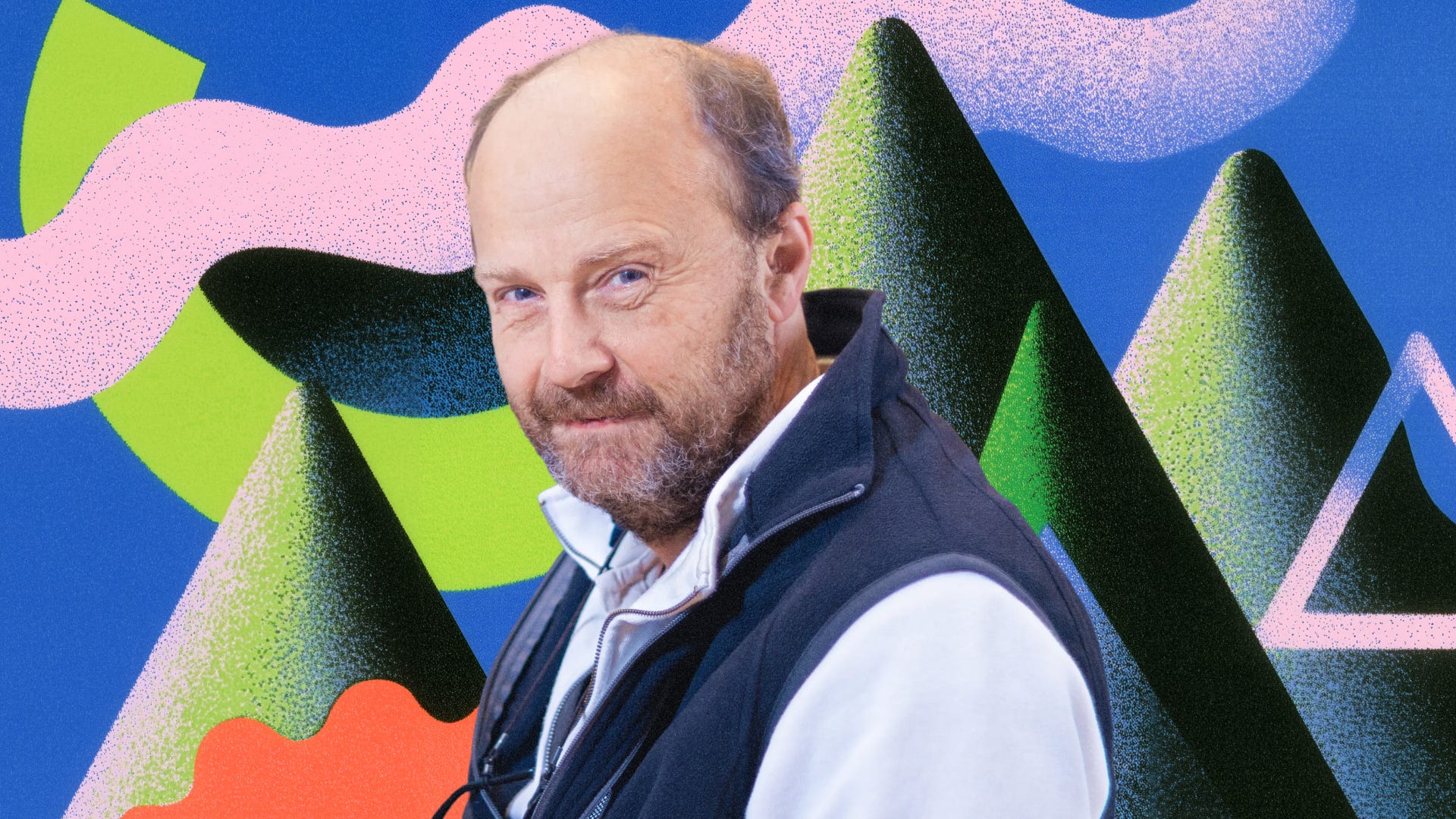
I first became aware of the Learning Planet Institute (LPI) this summer. Little did I know that I would have the opportunity to spend two immersive days on their beautiful campus just a few months later. October kicked off with the Deeply Human Summit in Paris, where around 100 of us gathered, shoes off, to explore what makes us human.
One of the striking voices was that of François Taddei, co-founder and president of LPI, and an internationally renowned researcher. With an undergraduate degree in physics and a PhD in evolutionary genetics, he has dedicated the past twenty years to stewarding the next generation of what he calls “ethical dreamers.” I spoke with him earlier this week via Zoom. The interview was edited for clarity and brevity.
- Melina Dunham, curator, regenerative programming, House of Beautiful Business
***
We gathered just over ten days ago at the Deeply Human Summit in Paris. Students around France were protesting then, and still are. LPI is based in Paris and a place of learning and a place for youth. Would you like to comment on what’s happening?
There are things that are specific to France and things that are rather generic. We’ve seen youth movements all over the world in the past few years. Whether it’s their education, their employment prospects, the state of democracies—or governance more generally in countries that don’t have democracies—climate change, mental health issues, or the impact of AI, which youth is using a lot but was not designed for them or with them—you have this disconnection that starts within generations, sometimes within families, which creates hyper-polarization in society.
“There at least used to be some sort of a meritocratic incentive to try to compete to be the best in the world. Now, that meritocracy is broken.”
The impact of AI is huge, both on education and early jobs, and youth see this. Governments are also in economic and financial crises, which tend to lead to growing dissatisfaction. At least in the past, there was the promise that you would get a job if you did well in school. Now, AI is better at mathematics than the most advanced mathematicians.
So, what’s left for the students to come? Especially in a country that puts mathematics at the top of the pyramid of academia. It creates a clear imbalance. So, why should I still learn to pass the test if a machine can outperform me? If that’s the only thing you learn, there is a crisis of meaning. There at least used to be some sort of a meritocratic incentive to try to compete to be the best in the world. Now, that meritocracy is broken.
In France, your social status, or the one of your parents, is the best predictor of your school success, which is the best predictor of your future economic success. At a baseline, we are a country with huge inequality, even though we put Liberté, Égalité, Fraternité in front of every school. Kids enter, see these words, and see that they don’t match. They don’t have freedom to learn what they want or do what they want in school. The égalité is not working anymore and the fraternité (in terms of ‘let’s live together and let’s learn together’) doesn’t exist there because it’s a hyper-competitive school system.
You have one rule at LPI, and it’s “don’t do something that makes me need to create another rule.” How did you come to this? How has it held up?
I learned about this rule from Hackerspace, an innovation-driven space where you learn to break the barriers of the known. It resonated with me, because my mother raised me like this. She was a 1968 graduate, so to speak. In France we say ‘il est interdit d’interdire,’ ‘it’s forbidden to forbid.’ I didn’t realize how much freedom she’d given me until I went to the army, where the number of degrees of freedom is minimum.
The way we’re trying to complement it these days is to say that while most places want their students to be the best in the world, we aim for our students to be the best for the world. More precisely, this means they become ethical dreamers who are able to dream and act on their dreams, provided their dreams don’t create nightmares for others, neither today nor tomorrow.
Interestingly, we don’t even have to repeat this to the students. We just have to invite them into that culture, and they spontaneously explore. In every system, there is a frame. And in every system, there are some degrees of freedom. But you’re not always aware of them and you’re not always invited to use them. And you’re even less invited to evolve them to create something more fruitful.
“While most places want their students to be the best in the world, we aim for our students to be the best for the world.”
So what we’ve done, again and again over the last 20 years, is that we’ve listened to the students, and to the world’s dynamics, and we’ve invited the students to do what is meaningful to them and to the future.
Would you like to expand on your methodology, and how it impacts your work of cultivating “ethical dreamers”?
Let me give some background on where the idea of ethical dreams came from, at least in my personal journey. In high school, we learned ‘science sans conscience n’est que ruine de l’âme,’ ‘science without consciousness can only ruin the soul.’ This quote is from François Rabelais’ 1532 novel Pantagruel, which I find fascinating. I used it in the opening of my PhD application in 1990. It resonated even more when I studied genetically modified organisms and was invited to join the ethics committee of the Biomedical Research Council at the end of the 90s, when GMOs and mammal cloning were frontline news.
Then 9/11 happened, I was in New York. I saw the towers go down. During that same period, Anthrax bioweapons were being used. My research, or at least not so distant research, designed to help cure could be also used to build bioweapons. I visited Hiroshima and Nagasaki in the summer of 2025 and was devastated by the suffering. I consider this the worst nightmare ever. But this is also the physics I’ve learned. That of Curie, Einstein, and others who were pacifists but contributed to the worst nightmare.
“We have declared we are homo sapiens sapiens. But anyone claiming to be wise cannot be very wise. And a species that has to repeat it twice must have a real problem.”
Science sans conscience n’est que ruine de l’âme becomes obvious here. That day in Nagasaki, I met an 11-year-old girl, the great-grand daughter of a survivor. She taught me to make origami, and I love to learn from young people, so I followed her. At the end of the exercise, she invited me to write what I wanted to protect on the origami, and she would pin it on the wall. So I wrote ‘next generation dreamers’ without even thinking about it. She asked me why I wrote this and I said, ‘I’m not sure, but I know that your great grandmother went through the worst nightmare. And I believe that you and your generation should be entitled to have the best possible dreams.’
In a few words, what does being a good ancestor mean for you?
I think it’s always important to know where we come from as a species and as individuals, to better understand where we are and where we’re going. My family comes from Corsica, and in our garden, there is an olive tree that is 1,000 years old. It was planted by some distant ancestors that I’ve never met. And yet, I can still eat the fruits of their labor. It took many generations to make sure that the tree would survive and would be taken care of. I am indebted to that sort of ancestry.
“Human, humus, and humility all have the same etymology which is fascinating—earth.”
So what do we do that will have a positive impact on, say, the 22nd century? Or the 4th millennia? Because we are blessed to be a UNESCO Center with LPI, I’ve been reflecting on their mission and their promotion of world heritage—what yesterday created for today, what we want to keep for tomorrow. Part of being a good ancestor is being a steward of what we have been gifted from the past. Be it natural, cultural, or architectural heritage.
A more open question, especially in these days of quickly evolving science and technology, is what sort of legacy, culture, science, and technology do we give birth to today that the world of tomorrow will want to keep for the world of after? It’s not just CO2 in the atmosphere and plastic in the oceans. That’s for sure. Some people talk about carbon footprints, but we also need cultural handprints. It’s more intentional. I like this metaphor, and the idea of planetary legacy.
There’s also this element of humility, which is one of the etymologies that you referenced at the Summit and resonant with what you’ve shared today as well.
Human, humus, and humility all have the same etymology which is fascinating—earth. So being a human means being an earthling. And the humus means we’ll get back there. We even say it; you were dust, and you’ll be dust again. We are stardust, and it’s amazing we are aware of it. We live in a very privileged position in time and space, but it’s transient. So let’s enjoy it. I like this saying, some say from Confucius: Your second life starts when you know you only have one life.
“What distinguishes us from both machines and other animals is not our intellect or emotions, but the fact that we are born the most vulnerable.”
And for me, there is a third life that starts when you know that life will continue after yours. So that’s some humility. And let’s make fun of ourselves. If you take yourself too seriously, you know, there’s a problem. Humor is very important, especially in reflecting on who we are. We have declared we are homo sapiens sapiens. But anyone claiming to be wise cannot be very wise. And a species that has to repeat it twice must have a real problem.
A new type of hubris.
We are born the most vulnerable on this planet. What makes us different from any other animal? For a long time, we thought it was thinking, but we are much more than our ability to produce logos. What distinguishes us from both machines and other animals is not our intellect or emotions, but the fact that we are born so vulnerable. And that we remain so the longest.
We claim we are autonomous, but put someone alone in the forest, and they won’t survive very long. We are a social species because we don’t want to be outcast. We want to stay with others because we know we are dependent on others. We are vulnerable, and we are interdependent. And if you understand that this is what defines us, then you’re a little more humble, and you’re a little more ready to serve others as much as they are serving you.
What a beautiful invitation for how we should redesign the next, 50, 100, 1000 years.
Our motto here is learning to care for self, others, and the planet. Which means that you have to be able to reconnect to yourself, including your own vulnerabilities, your history. If you go back far enough in time, you realize that we are all relatives. We all have common ancestors, and we’re all stardust. So are all the other animals on this planet.
“Propose new versions of the game. That’s what being human is. It always has been.”
If this introspection is done not just in a narcissistic way, but in a way that relates to what science says and to what history says, then you can realize that we have so much more in common and that the only meaningful thing we can really do is to make sure that the game remains playable.
However, we often optimize for games that were actually designed by humans for humans, like the economy or politics or the education system—games which maybe were meaningful yesterday because they contributed to the larger dynamics, but need to be redesigned.
If the game is painful for you, for others, and the next generation, then why should we play it? What’s interesting is that kids love to change the rules of the game. So you don’t even have to acquire this, you have not to lose it. You have to encourage those key questions and propose new versions of the game. And that’s what being human is. It always has been.
LPI is a UNESCO Center. How do you grapple with the current games, the current structures being pressure tested? How do you double down on your mission accordingly? How do you push to change those rules of those games?
Some sociologists of innovation came to study us. Because we were a strange animal in terms of the sociology of organizations. They defined us as what they call a ‘middle ground.’ The ‘upper ground’ is the institutions, say UNESCO, ministries, universities, schools. ‘On the ground’ are the people learning, teaching, living. ‘Underground’ you have people who are not very happy with the system, are trying to hack it or transform it. With more or less success.
A ‘middle ground’ is a third place that can interact with both the ‘upper ground’ and receive legitimacy from it, and remain agile enough to engage with people on the ‘ground,’ even people ‘underground’ who are challenging the system. We try to listen to everyone.
In terms of governance, we have our first general assembly this week. This includes institutions, experts and practitioners, and young people, each group equally represented. We use the UN definition of youth, so it’s people below 35, and our youngest member is 12 years old. We want to listen to what they have to bring to the conversation and the mission of this general assembly is to help us have this intentional dialogue. And to hear even the voices of those who are not in the room.
You’re an evolutionary biologist by training. Expand on that.
What I’ve been studying and researching is the way bacteria cooperate, the way they play games. It’s called experimental game theory. Because bacteria have a generation time of 20 minutes, in 24 hours you have billions of them. So you can study what happens over generations and generations pretty easily. You can evolve the way they evolve. You can see the way they evolve their own way to evolve. When they are in a fast-changing environment, they will accelerate their rate of change. They can mutate more, recombine more, transfer more, and adapt faster.
“Because bacteria have a generation time of 20 minutes, in 24 hours you have billions of them. So you can study what happens over generations and generations pretty easily.”
And you can show that they can cooperate, they can exchange information, they can cooperate on how to exchange information, and they can exchange information on how to cooperate. And they do this without any centralized system. There is no outside intelligence that says ‘do this.’ There is no ministry or school system. They just do it because it’s what’s needed to adapt to a changing environment.
Interestingly, they do this across species. If you look at antibiotic resistance, the most resistant bacteria typically carry genes that can come from ten different species. They exchange information across species in order to solve a complex challenge like resisting huge doses of antibiotics that our pharmaceutical industry uses to help us cure bacteria infection.
This is something that I’ve learned from them. I know that any social organism, including bacteria and us, are conditional cooperators. You cooperate when there is some benefit to cooperate. Otherwise, you compete. So are we cooperators or are we competitors? It depends on the environment we are in. We see it in sports. And schools can be the same.
That’s why we ask for an education system that is not competing on yesterday’s knowledge in a competition where you’re going to lose against a machine. Instead, let’s cooperate on our many challenges, maybe even with machines, to make a difference for yourself, for your community, and for future generations.
How can we apply this to tackling the climate crisis?
One of the things game theory teaches you is that you can cooperate directly, but you can also cooperate indirectly by producing something that everyone is going to need. For example, enzymes that degrade antibiotics for bacteria, or knowledge for us. It could be democracy or the quality of information. It could be the beauty and the health of the environment.
“We ask for an education system that is not competing on yesterday’s knowledge in a competition where you’re going to lose against a machine.”
You can either produce a public good or a public bad. Pollution is a public bad. Quality of water is a public good. As public goods can be polluted, privatized, over exploited and destroyed, we need to learn to preserve the public goods. We have natural public goods that predate our existence (like water quality, air quality, biodiversity). There are public goods that humans have invented; knowledge, democracy, quality of debate and social fabric. Then there are more recent digital public goods; the internet, open-source code, and everything that is co-created, like Wikipedia.
In the case of AI, we see that the private interests are superseding. It’s in our best interest to recognize that public goods need to be nurtured and preserved, not privatized and polluted. When thinking about the incentive for this new game—because we are cooperative only when it works in our interest—we should reward those that cooperate on the public goods. If we are rewarded for a contribution to the community, then the community will thrive. If we are rewarded only for our personal interest or private interest and no one cares for the community, the public goods that we all need will deteriorate. And as we all depend on them to survive and thrive, we’ll be in trouble.
It’s just non-beneficial behavior as a species. So, where are we going?
AI is coding itself and speeding up its own abilities to evolve. It’s able to do computing and mathematics at a level that is unprecedented. So honestly, no one knows. What I do know is that life has been full of surprises. There have been major transitions in evolution, and I believe we are in the middle of a new one.
I think that there is going to be at least a civilization transition, if not a transition that is equivalent to the appearance of life on this planet. There was a before and after the origin of life. And I think there is a before and after the appearance of artificial intelligence on this planet.
So how do we learn to co-evolve? Which is part of what I’ve learned from bacteria and other organisms. Life, for most of its evolution, has not been conscious of itself. We are among the happy few that are conscious. Thanks to science, we are a little more conscious about what the universe is like, what life was, and what it is now, and how it originated, and how it evolved.
“If we had 8 billion and more sets of dreams and nightmares, could an AI help us find the paths that maximize the numbers of dreams and minimize the numbers of nightmares?”
AI is not only evolving, that’s a given, but the question is whether it’s going to evolve in a conscious way. And if you evolve in a conscious way, you can start learning to be ethical. At the moment, it’s more or less ethical if we encode ethics in it. But that’s something we don’t know how to do well because we are not good at defining ethics.
Going back to this idea of ethical dreams, imagine if there was a database of 8 billion dreams and 8 billion nightmares—and more because we could interview our past, and also our next generation’s dreams and nightmares, and maybe other species’ dreams and nightmares. And we started having conversations. We could challenge each other, we could discuss, and we could evolve, and maybe we could learn that we can have some dreams in common, and we can learn to weave them together. You could apply this to a couple, a family, but it could also be for any community, even distant ones. It could become a planetary community of intelligent beings.
If we had 8 billion and more sets of dreams and nightmares, could an AI help us find the paths that maximize the numbers of dreams and minimize the numbers of nightmares? I believe that’s possible. That’s a future I would love to see and love to contribute to, because that’s the sort of thing I believe future generations can thank us for.
***

Our flagship gathering will take place on November 3-6, 2027 in Athens, Greece, bringing together 1,000 of the world’s most imaginative leaders for four days of insights, stories, and experiences that have no home anywhere else. Plus: This time, we’re extending our Athens presence beyond the Forum. For those who want to go deeper, connect, and take action, we’re creating a special pop-up space, The HoBB, in central Athens from October 20–November 20, 2027—during and for the two weeks before and after the Forum. The HoBB will host exhibitions, collaborations, coworking, and special programming throughout the month.

The Beautiful Business School is a one-of-a-kind online learning journey that provides you with a comprehensive, decidedly humanist playbook for the age of AI. Over the course of five weeks—January 26 to March 4, 2027—you’ll embark on a deep, dynamic journey into the art and practice of beautiful business. Through live sessions, expert guidance, improv, a curated library, and interaction with AI agents and a vibrant global community of peers, you’ll develop the creative insight and human leadership needed to shape a more beautiful future.

There’s never been a better time to become a paying member of the HoBB. Annual membership includes 20% off all events and products (including The Beautiful Business School and the World Beautiful Business Forum), as well as access to session recordings, both online and in-person, and other exclusive content. Your support is vital as we aim to continue offering free online programming and grow the community.
Community Updates
On October 18, HoBB co-founder Tim Leberecht will be in conversation about “The Inner Life of the Future: Leadership, Consciousness, and Human Flourishing in the Age of AI” with fellow HoBBsters, Mobius CEO Amy Elizabeth Fox and Dr. Angel Acosta, as part of the online conference Artificial Intelligence and Our Spiritual Imagination hosted by the Garrison Institute.
The Artificiality Summit, hosted by Dave and Helen Edwards, brings together thinkers, developers, and researchers to explore how AI is reshaping what it means to be human. The 2026 edition, themed Unknowing, takes place October 22–24 in Bend, Oregon.
In Re-imagining Finance, a film by Till Wittwer and Aris Komporozos-Athanasiou, the Global Consortium for Re-thinking Capitalism presents new possibilities for a more democratic, equitable, and sustainable financial future. Watch the film.
How can we protect our autonomy in a world increasingly shaped by AI and Big Tech? In a thought-provoking conversation, Alison Taylor speaks with Bruno Giussani about his new book, Our Minds Under Siege.
Following the launch of our new HoBB Hub Sofia and his recent keynote at the Future of Work summit, HoBB co-founder Tim Leberecht reflects on the role of humans in an AI-driven economy. In his post, he explores what Bulgaria can teach us about embracing complexity, navigating change, and preserving our humanity.
In his new book Reclaim Work (in German), Hans Rusinek rethinks work and its role in our lives, with a specific focus on the production of hope. Among the voices featured is HoBB co-founder Tim Leberecht.
Taking place in Panama City from November 8 to 11, the 2026 ICCA Congress brings new ideas on creativity, connection, and the future of gatherings to a global audience of conference and convention organizers, with curatorial and experience design support from the HoBB. Read more.
Sebastian Borget and his creative partner Arthur Madrid are making their first feature film: HOLLYWOOD HILLS, a cosmic horror story set on a Los Angeles celebrity death tour. They’re inviting audiences to become investors, starting at $200, through Republic.